Showing posts with label Sabbath. Show all posts

Saturday, April 19, 2025

The Passion Week: Saturday, the Sabbath

This Easter season, I’ve made a series of posts addressing skeptics’ criticism surrounding the Resurrection.  As we close in on Easter, I want to do a day-by-day detail discussing the events happening during the Passion Week. 

Please keep checking back!


Saturday


Being the Jewish Sabbath, not much would have been done on this day.  The disciples, shocked and demoralized, were probably hiding for fear that they too would find themselves facing religious and political persecution.  The only record in the gospels of what happened on this day is found in Matthew 27:


Matthew 27:62-66, Now the next day, that followed the day of the preparation, the chief priests and Pharisees came together unto Pilate, [s]aying, Sir, we remember that that deceiver said, while he was yet alive, After three days I will rise again. Command therefore that the sepulchre be made sure until the third day, lest his disciples come by night, and steal him away, and say unto the people, He is risen from the dead: so the last error shall be worse than the first. Pilate said unto them, Ye have a watch: go your way, make it as sure as ye can. So they went, and made the sepulchre sure, sealing the stone, and setting a watch.


For His entire public ministry, Jesus found Himself at odds with religious leaders.  His sincere and correct way of teaching the Law upset the hyper-literal and fruitless interpretation taught by the Pharisees.  Because He spoke as someone with authority, they wanted to see a sign from God, a miracle, to prove He had the authority to speak for God.  Jesus promised them one:


Matthew 12:38-40, Then certain of the scribes and of the Pharisees answered, saying, Master, we would see a sign from thee. But he answered and said unto them, An evil and adulterous generation seeketh after a sign; and there shall no sign be given to it, but the sign of the prophet Jonas: For as Jonas was three days and three nights in the whale's belly; so shall the Son of man be three days and three nights in the heart of the earth.


The Pharisees seemed to understand His words because, in their conversation with Pilate, they said, “[W]e remember that that deceiver said, while he was yet alive, After three days I will rise again.”  I think it’s interesting that they understood His words even better than the disciples did!  


Anyway, even when Jesus hung on the cross, they mocked Him, saying, “He saved others; himself he cannot save. If he be the King of Israel, let him now come down from the cross, and we will believe him” (Matthew 27:42).  That’s curious.  Still today, I have heard unbelievers say that if God came down and appeared to them, then they would believe.  I know comments like this are never sincere but I’m not sure of the point of them.  Do people say things like this in order to be condescending?  Or are they trying to convince other people that they are being open minded, saying they would believe if they had enough evidence?  I don’t know.


What they said to Pilate next strikes at the heart of the issue: “Command therefore that the sepulchre be made sure until the third day, lest his disciples come by night, and steal him away, and say unto the people, He is risen from the dead: so the last error shall be worse than the first.”


The Pharisees understood the power of the Resurrection.  They remembered that Jesus had promised the sign of Jonah to prove His authority.  If Jesus rose from the dead, then everything He said, did, and taught would be validated!  The Pharisees didn’t want that.  If Jesus remained dead in the tomb, then all of His promises would be there too, dead with Him.


Today, we have the full revelation of Scripture.  We have the written testimony of people who were eyewitnesses to His preaching, His miracles, and His Resurrection.  They are people who saw Him alive, saw Him die, and saw Him alive again!  If you believe in your heart He rose from the dead and accept Him as your Lord, you will be saved (Romans 10:9-10)!


But if people do not believe the Bible, if they do not believe the words written by the prophets and apostles as they were moved by the Holy Spirit, then no amount of “evidence” will convince them.  I’m reminded of the Parable of the Rich Man and Lazarus.  In the parable, Jesus tells us of a conversation between Abraham and the rich man.  From Hell, the rich man pleaded with Abraham:


Luke 16:27-31, Then [the rich man] said, I pray thee therefore, father [Abraham], that thou wouldest send [Lazarus] to my father's house: For I have five brethren; that he may testify unto them, lest they also come into this place of torment. Abraham saith unto him, They have Moses and the prophets; let them hear them. And he said, Nay, father Abraham: but if one went unto them from the dead, they will repent. And he said unto him, If they hear not Moses and the prophets, neither will they be persuaded, though one rose from the dead.


The Pharisees claimed to believe in Moses but they didn’t.  They claimed to be the sons of Abraham but they weren’t.  Had they believed in Moses and Abraham, then they would have believed in Jesus, but they didn’t - even though He rose from the dead!!

Monday, October 16, 2023

It's God's world so it's God's rules!

My wife and I lead an adult community group at my church (community groups were formerly called Sunday School classes). A while back, we did a series, looking at the Ten Commandments one by one. Now, I've studied apologetics for many years now and have talked a lot about creation and evolution so perhaps I've studied Genesis more than the average Christian. Even so, I surprised even myself with the number of times during this series that I referred to the creation to make a point. I thought it would be interesting to share a few of the thoughts I've had.

Before I even start with the commandments, we need to examine the whole premise of right and wrong. I've talked about this before but it's sometimes difficult to articulate what makes something “wrong.” Oh sure, many critics are quick to label something as wrong but if you ask an atheist why a certain thing is objectively wrong (besides his opinion), he usually responds with a lot of bluff and bluster.


At its root, something is “wrong” if it's not the way it ought to be. There has to be an objective standard of what is “right” and anything that does not conform to that standard is “wrong.” For example, to say it's wrong to murder someone implies that people ought not murder. Now, that sounds obvious but it's not necessarily so easy. During WWII, Hitler and the Nazis didn't think it was wrong to murder 6 million Jews. We might disagree but what makes our opinion “right” and Hitler's “wrong”? There has to be a transcendent standard, one that is greater than the shifting opinions of men, in order for right and wrong to truly exist.


Genesis 1:31 says, And God saw every thing that he had made, and, behold, it was very good. You see, when God created the world, He made things “the way they ought to be” and, by doing so, He defined exactly what is “good.”  Therefore, He is the One who judges if something is not the way it ought to be. His commandments aren't simply 10 suggestions on how to avoid difficulties; they tell us what is right and wrong. God alone is the final arbiter of morality. It's God's world so it's God's rules!


As we go through the commandments, see how often they are a direct reflection of His will at the creation.


I. I am the LORD thy God.... Thou shalt have no other gods before me. (Exodus 20:1-3)


Genesis 1:1 says, In the beginning God created the heaven and the earth. God alone is the Creator. There are no other gods. It's fitting that, in the first commandment, God establishes that He is the only one with the authority to command us. There should be no one else to whom we turn to ask what is right and what is wrong. There is no one else who can tell us how we ought to be or what we ought to do.


II. Thou shalt not make unto thee any graven image, or any likeness of any thing that is in heaven above, or that is in the earth beneath, or that is in the water under the earth. Thou shalt not bow down thyself to them, nor serve them. (Exodus 20:4-5)


In Jeremiah 2, God rebukes Israel for their worship of Baalim. In v. 27-28, He ridicules the worship of idols. Saying to a stock, Thou art my father; and to a stone, Thou hast brought me forth: for they have turned their back unto me, and not their face: but in the time of their trouble they will say, Arise, and save us. But where are thy gods that thou hast made thee? let them arise, if they can save thee in the time of thy trouble: for according to the number of thy cities are thy gods, O Judah.


God reminds His people that these graven idols were made by men and even though the idols may have hands and feet, they still can do nothing. Yet the people pray to them, saying to the wood, “You are my father,” and to the stone, “You have made me.” Romans 1:25 talks about idolatrous people, Who changed the truth of God into a lie, and worshiped and served the creature more than the Creator, who is blessed for ever. Amen.


III. Thou shalt not take the name of the LORD thy God in vain. (Exodus 20:7)


In Genesis 2:19-20, we read, [W]hatsoever Adam called every living creature, that was the name thereof. And Adam gave names to all cattle, and to the fowl of the air, and to every beast of the field.


Perhaps Adam naming the animals is like letting a child name the family pet. God gave Adam dominion over all the earth. To demonstrate to Adam that he had authority over the animals, God allowed Adam to name the animals in the Garden. The right to name something is a definitive test that you have authority over that thing.


Of course, we don't have authority over God. We can’t call God anything we want.  We must address Him in the way He deserves to be addressed – with respect, with humility, and with reverence.


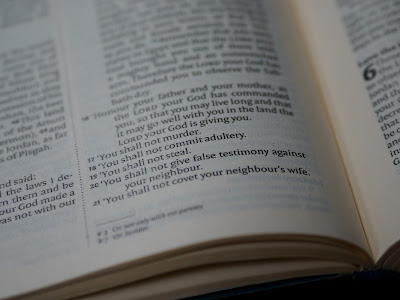
IV. Remember the sabbath day, to keep it holy. Six days shalt thou labour, and do all thy work: But the the seventh day is the sabbath of the Lord thy God: in it thou shalt not do any work.... For in six days the LORD made heaven and earth, the sea, and all that in them is, and rested the seventh day: wherefore the Lord blessed the sabbath day, and hallowed it. (Exodus 20:8-11)


I find it interesting that God actually referenced the creation account in this commandment.  The six days of creation having been accomplished, God ends His creation with a Sabbath. Of course, God wasn't “tired” and in need of rest. Instead, He “rested” in the sense that He ceased His labor. We might compare it to a “rest” in a piece of music where the music pauses deliberately and not because the performer is tired.  It was an intentional act and He did it seemingly to be an example for us.  Now, He commands us to do as He did.


Christians often do not give the Sabbath its due reverence.  When God made the universe, He also created the Sabbath. It was deliberate.  It was intended.  It was an act distinct from all the creative acts of the first six days.  Do you think, then, that God takes the Sabbath seriously? 


V. Honour thy father and thy mother (Exodus 20:12)


Genesis 1:28 says, “And God blessed them, and God said unto them, Be fruitful, and multiply, and replenish the earth.”


When God created the angels, He apparently made a host of them. Jesus made it clear that angels do not marry (Matthew 22:30) which suggests they do not reproduce. God could have created humans in the same way. Instead, He created only two people and commanded them to reproduce together and fill the earth. The parent/child relationship was part of His divine plan. God created the family.


VI. Thou shalt not kill.


It would be ridiculously obvious to say that God is the Author of life. But we seldom stop to consider how overtly this is attested in the Bible. In Genesis 1:20-24, we read the following: “And God said, Let the waters bring forth abundantly the moving creature that hath life, and fowl that may fly above the earth in the open firmament of heaven. And God created great whales, and every living creature that moveth, which the waters brought forth abundantly, after their kind, and every winged fowl after his kind: and God saw that it was good.... Let the earth bring forth the living creature after his kind, cattle, and creeping thing, and beast of the earth after his kind: and it was so.”


When God made man, Genesis 2:7 also described him as living: “And the LORD God formed man of the dust of the ground, and breathed into his nostrils the breath of life; and man became a living soul.”


God not only created the living animals, He created essentially what it means to be alive. As the Creator of life, it is God's exclusive right to say when and how it is acceptable to take a life. Eating animals is allowed. Executing criminals is allowed. Murder is never allowed.


VII. Thou shalt not commit adultery. (Exodus 20:14)


When God made man, we read that His plan was that man should not be alone. Genesis 2:18-24 reads, “And the LORD God said, It is not good that the man should be alone; I will make him an help meet for him.... And the LORD God caused a deep sleep to fall upon Adam, and he slept: and he took one of his ribs, and closed up the flesh instead thereof; And the rib, which the LORD God had taken from man, made he a woman, and brought her unto the man. And Adam said, This is now bone of my bones, and flesh of my flesh: she shall be called Woman, because she was taken out of Man. Therefore shall a man leave his father and his mother, and shall cleave unto his wife: and they shall be one flesh.”


When Jesus was asked about marriage in Matthew 19:4-5, He referred them back to the creation account in Genesis. Marriage is not a social contract invented by men. It was the divine will of the Father from the very beginning of history. Marriage is unequivocally one man uniting with one woman for life.


VIII. Thou shalt not steal (Exodus 20:15)


In Acts 5:4, when Ananias had held back a portion of the proceeds he'd made from selling some property, Peter asked him, rhetorically, “Whiles it remained, was it not thine own? and after it was sold, was it not in thine own power?” Peter seems to affirm that the property Ananias sold was his own and he had the right to do anything he wanted with the money. There are several places in the Bible that affirm what we might call capitalism but I can't think of any passage that overtly says, “you have a right to own things.” It's more like it's simply understood to be true.


This implicit understanding goes all the way back to the Garden.  Genesis 2:15-17, “And the LORD God took the man, and put him into the garden of Eden to dress it and to keep it. And the LORD God commanded the man, saying, Of every tree of the garden thou mayest freely eat: But of the tree of the knowledge of good and evil, thou shalt not eat of it: for in the day that thou eatest thereof thou shalt surely die.”


God seems to set a boundary with Adam where He says, “This is mine and everything else is yours.”


IX. Thou shalt not bear false witness against thy neighbour. (Exodus 20:16)


In John 8:44, Jesus calls the Pharisees, sons of the devil. He said, “Ye are of your father the devil, and the lusts of your father ye will do. He was a murderer from the beginning, and abode not in the truth, because there is no truth in him. When he speaketh a lie, he speaketh of his own: for he is a liar, and the father of it.”


Satan is indeed the father of lies. In his encounter with Eve, the serpent spoke the first lies recorded in the Bible. Genesis 3:1-5, “Now the serpent was more subtil than any beast of the field which the LORD God had made. And he said unto the woman, Yea, hath God said, Ye shall not eat of every tree of the garden? And the woman said unto the serpent, We may eat of the fruit of the trees of the garden: But of the fruit of the tree which is in the midst of the garden, God hath said, Ye shall not eat of it, neither shall ye touch it, lest ye die. And the serpent said unto the woman, Ye shall not surely die: For God doth know that in the day ye eat thereof, then your eyes shall be opened, and ye shall be as gods, knowing good and evil.”


X. Thou shalt not covet (Exodus 20:17)


The lies of Satan beguiled Eve and she began to covet. Genesis 3:6 says, “And when the woman saw that the tree was good for food, and that it was pleasant to the eyes, and a tree to be desired to make one wise, she took of the fruit thereof, and did eat, and gave also unto her husband with her; and he did eat.”


Coveting is easily the most violated commandment. In Matthew 5:27-28, Jesus explained that adultery included not only the physical act, but even the desire to do the act. The Bible says that what a man thinks in his heart, so is he (Proverbs 23:7). I didn't become a liar, for example, when I told my first lie. I became a liar when I conceived in my mind that I would tell a lie. When I finally spoke the lie, I was just doing what liars do. Those who lust are adulterers, those who hate are murderers, and those who envy are thieves.


Eve didn't disobey God when she ate the fruit; she disobeyed God when she desired to eat the fruit. The same is true for Adam.


In conclusion, we can see the commandments are not simply a list of arbitrary rules.  By understanding the creation account, we understand how things ought to be.  Therefore, we can know why these things are wrong.

Tuesday, July 25, 2023

Some Comments on the Creation Week: Day 7 - conclusion

A while back, I taught a short series on creation for my Sunday school class. It was supposed to last for the summer and I had planned on covering several topics like the role of creation in evangelism, various ways some Christians reinterpret Genesis in order to fit it with popular scientific theories, and how to answer some of the more common objections people raise against creation. One lesson I had planned was to cover the days of the creation week, giving a short description on what happened each day. However, there were so many questions asked and such interest shown that the single lesson I had planned ended up being stretched over 5 lessons.

It was during that time that I realized that, even though the language of Genesis 1 is straightforward and easy to read, many Christians don't stop to consider the full impact of what is happening on each day – not so much from a spiritual perspective but rather from a physical one. To that end, I thought it would be worthwhile to have a short series of posts, each covering one day of the creation week. This isn't meant to be a treaty on the subject. Instead, I hope to simply open a few eyes to the realization that what is being described were real events that literally shaped the world. Even so, the posts will be a little longer than usual.  I apologize in advance and only say that I will do my best to make them worth the while to read.


In this post, we will conclude this series with a discussion of Day 7, the Sabbath.


Genesis 2:1-4, Thus the heavens and the earth were finished, and all the host of them. And on the seventh day God ended his work which he had made; and he rested on the seventh day from all his work which he had made. And God blessed the seventh day, and sanctified it: because that in it he had rested from all his work which God created and made.  These are the generations of the heavens and of the earth when they were created, in the day that the Lord God made the earth and the heavens.


The six days of creation having been accomplished, God ends His creation with a Sabbath. Of course, God wasn't “tired” and in need of rest. Instead, He “rested” in the sense that He ceased His labor. We might compare it to a “rest” in a piece of music where the music pauses deliberately and not because the performer is tired.


While the 7th day is marked by no work, there is still a lot we can glean from this passage. As I've done in previous posts, I'm going to break this passage down verse by verse.


v. 1, Thus the heavens and the earth were finished, and all the host of them.


The clause, “and all the host of them,” is significant. Everything that exists in heaven and earth was created in the six preceding days. The “host” - meaning the stars, the sun, the earth, the seas, the plants, the animals, man, and every other created thing - came to be in the span of those six ordinary days. There is no room for millions or billions of years.


v. 2, And on the seventh day God ended his work which he had made; and he rested on the seventh day from all his work which he had made.


This verse says God ended His work. This wasn't just a pause (as in my musical analogy); God “ended” His work. The universe He intended to create had been accomplished and God is no longer creating. This conforms nicely with the 1st Law of Thermodynamics that roughly says no new matter/energy is being created. It's a sort of prediction being made by the Bible. God created natural processes and the universe continues largely under their divinely appointed rules. Of course, Jesus performed creative acts, such as the multiplication of the loaves and fish or the turning of water to wine. It is precisely because we know new things don't naturally appear that we can be certain these acts were supernatural.


Conversely, the fact that God ended His work contradicts the theory of Theistic Evolution. According to TE, God continuously created from the moment of the Big Bang to the creation of man billions of years later. According to evolutionists, stars are still being created (even though we've never seen it happen) and they say animals continue to evolve so God's creative work has never really ceased.


v. 3, And God blessed the seventh day, and sanctified it: because that in it he had rested from all his work which God created and made.


God could have created the universe in as short or as long a period of time that He wanted. He could have created it instantly. He could have created it over the course of billions of years. It's not a question of what He could have done but rather what He has done. He deliberately chose seven days.


Perhaps one reason He chose the seven day week was to set a precedent for us to follow. In Exodus 20:8-11, we read the following:


Remember the sabbath day, to keep it holy. Six days shalt thou labour, and do all thy work: But the seventh day is the sabbath of the Lord thy God: in it thou shalt not do any work, thou, nor thy son, nor thy daughter, thy manservant, nor thy maidservant, nor thy cattle, nor thy stranger that is within thy gates: For in six days the Lord made heaven and earth, the sea, and all that in them is, and rested the seventh day: wherefore the Lord blessed the sabbath day, and hallowed it. 


God has purposefully established our seven day week to mirror the seven day creation week. This would make sense only if these were seven, ordinary days. The passage is unambiguous. Everything in heaven and earth was created in only six days and the LORD rested on the seventh. Again, there is no room for millions or billions of years.


v. 4, These are the generations of the heavens and of the earth when they were created, in the day that the Lord God made the earth and the heavens.


Before I conclude, let me highlight an amusing aside. Note the use of the word “day” in this passage: “in the day that he LORD God made the earth and the heavens.” In this context, the word covers the entire week of creation and not just a 24 hour period. Theistic evolutionists often argue that since “day” has several meanings, it could mean millions or billions of years in Genesis 1. We see here an example of such a use where the word day clearly means more than 24 hours. However, young-earth creationists never argue that “day” can only mean 24 hours. Instead, we interpret the Bible according to a plain reading of the text. 


The context here clearly shows the meaning of the word. In Genesis 1, it clearly means a single evening and morning (i.e. – a single rotation of the earth). I've wondered before why it is that seemingly bright people can understand the meaning of the word “day” every other time it is used in the Bible except for Genesis? //RKBentley scratches his head//


Moving on....


The narrative of the creation ends with the labeling, “these are the generations of the heaven and earth.” The inclusion of the title at the end of the chronology rather than the beginning like we might expect had stymied scholars for centuries. The “book of the generations of Adam,” for example, which details Adam's creation, the Fall, the Curse, the murder of Abel, and the birth of Seth, begins in Genesis 2:5 and ends in Genesis 5:2. Perhaps this is what led to the confusion that Genesis 2 was a second creation account; that is, people believed it was introducing a chronology rather than concluding one.


So there they are. The generations of the heavens and earth as clearly told to us in Genesis 1. Time, space, matter, sea, air, land, plants, animals, and man – all created in six ordinary days with God resting on the seventh. One week. No mystery. No ambiguity. No billions of years!