Wednesday, February 7, 2024

Dawkins versus Dawkins


For the last decade or so, there has been a brand of atheist which some have called, the “new atheists.” They're a peculiar breed who have adopted a different strategy in combating religion. Rather than simply argue about the (supposed) lack of evidence for God, they seek to demonize religion. To them, religion isn't just simply untrue, it's evil and so shouldn't exist. To that end, they lie, malign, demean, and demonize religion in general and Christianity in particular. As is always the case with godless apologetics, such a tactic is rife with contradictions and inconsistencies.

People on the ideological left seem to think the greatest sin is hypocrisy.  Considering their lifestyles, hypocrisy may be the only thing they think is a sin.  For example, leftist ideologies often seem to embrace sexual depravity.  Things like premarital sex, polygamous relationships, or gay “marriage” are called, “lifestyles,” while conservative Christians consider these activities to be sin.  What happens, then, when a high-profile pastor is caught having an affair?  Invariably, he’s called a hypocrite.


By calling their critics, hypocrites, lefties are really engaging in a type of type of ad hominem. They want us to believe that, since the pastor engaged in sexual sin, then anything he or the Bible says about sexual sin must be false.  The same people who engage in promiscuous sex, will often use the pastor’s moral failings as a justification for their own illicit behavior! 


I look at hypocrisy in a more philosophical sense. In logic, contradictory statements cannot be true. There is a rule in logic known as the law of non-contradiction. In a nutshell, something cannot be “A” and “not-A” at the same time in the same sense.  So, when I talk about hypocrisy, I'm not necessarily concerned about the hypocrite's character. The usual reason that I point out hypocrisy is to show the contradictory nature, and thus the invalidity, of an argument. If a critic contradicts himself, then his argument cannot be true; one premise or the other (or both) must be false. In this sense, hypocrisy is very relevant to a debate.


A chief proponent of the new atheist movement is Richard Dawkins. Dawkins is not only an archetype of the new atheist, he is also a very gifted speaker. His is an especially venomous approach and he has a way with words that makes his arguments sound compelling - that is, if you can overlook the contempt he holds while he speaks them. I'm not trying to question his motives, mind you; if his arguments are sound, it doesn't matter why he makes them. Even so, he is so malicious that he often sounds as though he is simply ranting. It's hard to take someone seriously who does nothing but whine.


Now, because Dawkins is such a prolific author and speaker, there are plenty of his quotes I have at my disposal with which I can expose the fallacies that plague the arguments of new atheism.  Let's look at a few.


A typical approach by folks of this stripe is to highlight examples of “immoral” passages from the Bible. Typically, critics use loaded words when describing these passages. For example, 1 Samuel 15:2-3 is described as “genocide” and Proverbs 23:13 is described as “child abuse.” This type of argument is sometimes called the argument of outrage.  It's not really evidence of anything. Instead, it's merely using highly charged wording to make the subject sound bad.


Besides being an argument of outrage, it’s also non sequitur – that is, the conclusion doesn’t follow the premise. When atheists make arguments like this, they are saying something like, “Evil exists, therefore there is no God.” How does that make any sense? That would be like saying, “Crimes happen, therefore there are no police.” Obviously, such a statement is absurd on its face. The morality of something (or lack of morality) is not necessarily evidence of its truthfulness.


Keeping all this in mind, look at this quote made by Dawkins in his book, River Out Of Eden: A Darwinian View Of Life.


“In a universe of electrons and selfish genes, blind physical forces and genetic replication, some people are going to get hurt, other people are going to get lucky, and you won't find any rhyme or reason in it, nor any justice. The universe that we observe has precisely the properties we should expect if there is, at bottom, no design, no purpose, no evil, no good, nothing but pitiless indifference.”


So, according to Dawkins, there's no evil, no good, and no purpose. Some people get hurt and some people get lucky and that's just the way it is.  Everything is just nature being nature and whatever fortune befalls us only comes from nature's “pitiless indifference.” But in typical, irrational fashion, Dawkins doesn't apply his worldview consistently. Consider the following quote:


“Faith can be very very dangerous, and deliberately to implant it into the vulnerable mind of an innocent child is a grievous wrong.”

The God Delusion


Note his use of the word, “wrong.” On what grounds does he consider it wrong? By his own words, there is nothing but “pitiless indifference.” He might as well say that an apple falling from a tree is “wrong.”  The only way Dawkins could call anything wrong is if he were first to concede that there is right and wrong.  Yet these do not exist in the godless universe he described so in order to say it's "wrong" to teach a child religion, Dawkins must first assume the biblical idea that there is an absolute standard of morality.  Ironic, huh?


Let me give you another quote by Dawkins.


“Unfortunately, however much we may deplore something, it does not stop being true.”

The Selfish Gene


He’s made this point more than once.  In his book, The Greatest Show on Earth: The Evidence for Evolution, he also said the following:


“Even if it were true that evolution, or the teaching of evolution, encouraged immorality that would not imply that the theory of evolution was false.”

If Dawkins truly feels this way, why does he devote the entire book, The God Delusion, to describing how deplorable he thinks religion is? From this book we read:


“Yahweh: The God of the Old Testament is arguably the most unpleasant character in all fiction: jealous and proud of it; a petty, unjust, unforgiving control-freak; a vindictive, bloodthirsty ethnic cleanser, a misogynistic, homophobic, racist, infanticidal, genocidal, filicidal, pestilential, megalomaniacal, sadomasochistic, capriciously malevolent bully.”


How strange. It seems that when Dawkins presents his own points of view, the moral consequences of his positions aren't relevant. However, when attacking religion, Dawkins thinks that its alleged immorality is a fine reason to reject it.  Dawkins is correct in the first point: evolution is not false because it is an amoral theory (it's false for a lot of other reasons). But by that same token, neither is Christianity proven false on the sophomoric grounds that some people find certain passages objectionable.  Even if every word in his libelous characterization of God were true, he hasn't spoken anything against His existence. 


Dawkins’ statements contradict each other. In one case, Dawkins says there is “no justice,... no purpose, no evil, [and] no good.” In another, Dawkins says it is a “grievous wrong” for parents to impart their religion to their children. Both statements cannot be true, therefore I seek to examine which premise is false. If the first is true, then Dawkins has no grounds to say Christians are wrong to do anything. If the latter is true, then Dawkins cannot say the universe is void of good and evil. Either way, Dawkins' arguments are undermined.


I find Dawkins' gross hypocrisy and total lack of coherence to be abominable. Is that evidence that Dawkins doesn't exist? Oh, if it were only that easy! I never cease to be amazed at the self-defeating arguments used by atheists. In one breath Dawkins says that evolution is true no matter its morality; then in the next breath he says religion is false because of its morality. Such is the way of the irrational.

Monday, October 16, 2023

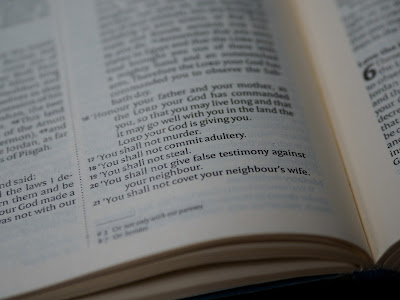
It's God's world so it's God's rules!

My wife and I lead an adult community group at my church (community groups were formerly called Sunday School classes). A while back, we did a series, looking at the Ten Commandments one by one. Now, I've studied apologetics for many years now and have talked a lot about creation and evolution so perhaps I've studied Genesis more than the average Christian. Even so, I surprised even myself with the number of times during this series that I referred to the creation to make a point. I thought it would be interesting to share a few of the thoughts I've had.

Before I even start with the commandments, we need to examine the whole premise of right and wrong. I've talked about this before but it's sometimes difficult to articulate what makes something “wrong.” Oh sure, many critics are quick to label something as wrong but if you ask an atheist why a certain thing is objectively wrong (besides his opinion), he usually responds with a lot of bluff and bluster.


At its root, something is “wrong” if it's not the way it ought to be. There has to be an objective standard of what is “right” and anything that does not conform to that standard is “wrong.” For example, to say it's wrong to murder someone implies that people ought not murder. Now, that sounds obvious but it's not necessarily so easy. During WWII, Hitler and the Nazis didn't think it was wrong to murder 6 million Jews. We might disagree but what makes our opinion “right” and Hitler's “wrong”? There has to be a transcendent standard, one that is greater than the shifting opinions of men, in order for right and wrong to truly exist.


Genesis 1:31 says, And God saw every thing that he had made, and, behold, it was very good. You see, when God created the world, He made things “the way they ought to be” and, by doing so, He defined exactly what is “good.”  Therefore, He is the One who judges if something is not the way it ought to be. His commandments aren't simply 10 suggestions on how to avoid difficulties; they tell us what is right and wrong. God alone is the final arbiter of morality. It's God's world so it's God's rules!


As we go through the commandments, see how often they are a direct reflection of His will at the creation.


I. I am the LORD thy God.... Thou shalt have no other gods before me. (Exodus 20:1-3)


Genesis 1:1 says, In the beginning God created the heaven and the earth. God alone is the Creator. There are no other gods. It's fitting that, in the first commandment, God establishes that He is the only one with the authority to command us. There should be no one else to whom we turn to ask what is right and what is wrong. There is no one else who can tell us how we ought to be or what we ought to do.


II. Thou shalt not make unto thee any graven image, or any likeness of any thing that is in heaven above, or that is in the earth beneath, or that is in the water under the earth. Thou shalt not bow down thyself to them, nor serve them. (Exodus 20:4-5)


In Jeremiah 2, God rebukes Israel for their worship of Baalim. In v. 27-28, He ridicules the worship of idols. Saying to a stock, Thou art my father; and to a stone, Thou hast brought me forth: for they have turned their back unto me, and not their face: but in the time of their trouble they will say, Arise, and save us. But where are thy gods that thou hast made thee? let them arise, if they can save thee in the time of thy trouble: for according to the number of thy cities are thy gods, O Judah.


God reminds His people that these graven idols were made by men and even though the idols may have hands and feet, they still can do nothing. Yet the people pray to them, saying to the wood, “You are my father,” and to the stone, “You have made me.” Romans 1:25 talks about idolatrous people, Who changed the truth of God into a lie, and worshiped and served the creature more than the Creator, who is blessed for ever. Amen.


III. Thou shalt not take the name of the LORD thy God in vain. (Exodus 20:7)


In Genesis 2:19-20, we read, [W]hatsoever Adam called every living creature, that was the name thereof. And Adam gave names to all cattle, and to the fowl of the air, and to every beast of the field.


Perhaps Adam naming the animals is like letting a child name the family pet. God gave Adam dominion over all the earth. To demonstrate to Adam that he had authority over the animals, God allowed Adam to name the animals in the Garden. The right to name something is a definitive test that you have authority over that thing.


Of course, we don't have authority over God. We can’t call God anything we want.  We must address Him in the way He deserves to be addressed – with respect, with humility, and with reverence.


IV. Remember the sabbath day, to keep it holy. Six days shalt thou labour, and do all thy work: But the the seventh day is the sabbath of the Lord thy God: in it thou shalt not do any work.... For in six days the LORD made heaven and earth, the sea, and all that in them is, and rested the seventh day: wherefore the Lord blessed the sabbath day, and hallowed it. (Exodus 20:8-11)


I find it interesting that God actually referenced the creation account in this commandment.  The six days of creation having been accomplished, God ends His creation with a Sabbath. Of course, God wasn't “tired” and in need of rest. Instead, He “rested” in the sense that He ceased His labor. We might compare it to a “rest” in a piece of music where the music pauses deliberately and not because the performer is tired.  It was an intentional act and He did it seemingly to be an example for us.  Now, He commands us to do as He did.


Christians often do not give the Sabbath its due reverence.  When God made the universe, He also created the Sabbath. It was deliberate.  It was intended.  It was an act distinct from all the creative acts of the first six days.  Do you think, then, that God takes the Sabbath seriously? 


V. Honour thy father and thy mother (Exodus 20:12)


Genesis 1:28 says, “And God blessed them, and God said unto them, Be fruitful, and multiply, and replenish the earth.”


When God created the angels, He apparently made a host of them. Jesus made it clear that angels do not marry (Matthew 22:30) which suggests they do not reproduce. God could have created humans in the same way. Instead, He created only two people and commanded them to reproduce together and fill the earth. The parent/child relationship was part of His divine plan. God created the family.


VI. Thou shalt not kill.


It would be ridiculously obvious to say that God is the Author of life. But we seldom stop to consider how overtly this is attested in the Bible. In Genesis 1:20-24, we read the following: “And God said, Let the waters bring forth abundantly the moving creature that hath life, and fowl that may fly above the earth in the open firmament of heaven. And God created great whales, and every living creature that moveth, which the waters brought forth abundantly, after their kind, and every winged fowl after his kind: and God saw that it was good.... Let the earth bring forth the living creature after his kind, cattle, and creeping thing, and beast of the earth after his kind: and it was so.”


When God made man, Genesis 2:7 also described him as living: “And the LORD God formed man of the dust of the ground, and breathed into his nostrils the breath of life; and man became a living soul.”


God not only created the living animals, He created essentially what it means to be alive. As the Creator of life, it is God's exclusive right to say when and how it is acceptable to take a life. Eating animals is allowed. Executing criminals is allowed. Murder is never allowed.


VII. Thou shalt not commit adultery. (Exodus 20:14)


When God made man, we read that His plan was that man should not be alone. Genesis 2:18-24 reads, “And the LORD God said, It is not good that the man should be alone; I will make him an help meet for him.... And the LORD God caused a deep sleep to fall upon Adam, and he slept: and he took one of his ribs, and closed up the flesh instead thereof; And the rib, which the LORD God had taken from man, made he a woman, and brought her unto the man. And Adam said, This is now bone of my bones, and flesh of my flesh: she shall be called Woman, because she was taken out of Man. Therefore shall a man leave his father and his mother, and shall cleave unto his wife: and they shall be one flesh.”


When Jesus was asked about marriage in Matthew 19:4-5, He referred them back to the creation account in Genesis. Marriage is not a social contract invented by men. It was the divine will of the Father from the very beginning of history. Marriage is unequivocally one man uniting with one woman for life.


VIII. Thou shalt not steal (Exodus 20:15)


In Acts 5:4, when Ananias had held back a portion of the proceeds he'd made from selling some property, Peter asked him, rhetorically, “Whiles it remained, was it not thine own? and after it was sold, was it not in thine own power?” Peter seems to affirm that the property Ananias sold was his own and he had the right to do anything he wanted with the money. There are several places in the Bible that affirm what we might call capitalism but I can't think of any passage that overtly says, “you have a right to own things.” It's more like it's simply understood to be true.


This implicit understanding goes all the way back to the Garden.  Genesis 2:15-17, “And the LORD God took the man, and put him into the garden of Eden to dress it and to keep it. And the LORD God commanded the man, saying, Of every tree of the garden thou mayest freely eat: But of the tree of the knowledge of good and evil, thou shalt not eat of it: for in the day that thou eatest thereof thou shalt surely die.”


God seems to set a boundary with Adam where He says, “This is mine and everything else is yours.”


IX. Thou shalt not bear false witness against thy neighbour. (Exodus 20:16)


In John 8:44, Jesus calls the Pharisees, sons of the devil. He said, “Ye are of your father the devil, and the lusts of your father ye will do. He was a murderer from the beginning, and abode not in the truth, because there is no truth in him. When he speaketh a lie, he speaketh of his own: for he is a liar, and the father of it.”


Satan is indeed the father of lies. In his encounter with Eve, the serpent spoke the first lies recorded in the Bible. Genesis 3:1-5, “Now the serpent was more subtil than any beast of the field which the LORD God had made. And he said unto the woman, Yea, hath God said, Ye shall not eat of every tree of the garden? And the woman said unto the serpent, We may eat of the fruit of the trees of the garden: But of the fruit of the tree which is in the midst of the garden, God hath said, Ye shall not eat of it, neither shall ye touch it, lest ye die. And the serpent said unto the woman, Ye shall not surely die: For God doth know that in the day ye eat thereof, then your eyes shall be opened, and ye shall be as gods, knowing good and evil.”


X. Thou shalt not covet (Exodus 20:17)


The lies of Satan beguiled Eve and she began to covet. Genesis 3:6 says, “And when the woman saw that the tree was good for food, and that it was pleasant to the eyes, and a tree to be desired to make one wise, she took of the fruit thereof, and did eat, and gave also unto her husband with her; and he did eat.”


Coveting is easily the most violated commandment. In Matthew 5:27-28, Jesus explained that adultery included not only the physical act, but even the desire to do the act. The Bible says that what a man thinks in his heart, so is he (Proverbs 23:7). I didn't become a liar, for example, when I told my first lie. I became a liar when I conceived in my mind that I would tell a lie. When I finally spoke the lie, I was just doing what liars do. Those who lust are adulterers, those who hate are murderers, and those who envy are thieves.


Eve didn't disobey God when she ate the fruit; she disobeyed God when she desired to eat the fruit. The same is true for Adam.


In conclusion, we can see the commandments are not simply a list of arbitrary rules.  By understanding the creation account, we understand how things ought to be.  Therefore, we can know why these things are wrong.

Monday, October 9, 2023

Happy Columbus Day!

In spite of the popular misconception, very few people in Columbus’s day still believed the world was flat. Columbus did not make his famous voyage to prove the world was round. Rather, it was Columbus who first realized that, because the world was round, one could reach Asia by sailing west from Europe.

The motives of Columbus are much maligned. Admittedly, Columbus understood the commercial benefit of a more direct route to India but in his heart Columbus was more of an evangelist than an explorer.  In his writing, the Book of Prophecies (excerpt here) Columbus wrote the following:


It was the Lord who put into my mind (I could feel His hand upon me) the fact that it would be possible to sail from here to the Indies. All who heard of my project rejected it with laughter, ridiculing me.  There is no question that the inspiration was from the Holy Spirit, because he comforted me with rays of marvelous illumination from the Holy Scriptures, a strong and clear testimony from the forty-four books of the Old Testament, from the four Gospels, and from the twenty-three Epistles of the blessed Apostles, encouraging me continually to press forward, and without ceasing for a moment they now encourage me to make haste….


I said that some of the prophecies remained yet to be fulfilled. These are great and wonderful things for the earth, and the signs are that the Lord is hastening the end. The fact that the Gospel must still be preached to so many lands in such a short time — this is what convinces me.


The name Christopher, in Greek, means bearer of Christ.  Columbus believed the return of Christ was imminent and it was his desire to fulfill the Great Commission and take the gospel into all the world. What an admirable goal that is and one worthy of emulation. Though Jesus has tarried another five centuries since Columbus, the Bible warns us we must always be vigilant lest His return should catch us unaware (Matthew 25:1-13).


I think Columbus Day should not be celebrated as the day Columbus discovered the New World. Rather, I think it should be a reminder that we need to continue in the work he started. With today’s technology of television, radio, and the internet, we can reach far more people than Columbus could ever hope to. Let’s look for new ways to take the gospel to the lost.


When Columbus landed on the first island of the New World, he christened it, “San Salvador” which means “Holy Savior.” He knelt on the island and offered a prayer. On this Columbus day, I’ve modified that prayer slightly and offer it now:


O Lord, Almighty and everlasting God, by Thy holy Word Thou hast created the heaven, and the earth, and the sea; blessed and glorified be Thy Name, and praise be Thy Majesty, which hath deigned to use us, Thy humble servants, that Thy holy Name may be proclaimed in [all] of the earth.


Amen!! Happy Columbus Day!!

Wednesday, September 27, 2023

A monopoly on the evidence


I guess all writers have their own style. I know I do. For example, I know that I often begin sentences with “I” and “For example.” Anyway, when dealing with a subject that is often misunderstood – like evolution is – I constantly try to seek out new ways to explain the most commonly misunderstood parts. I sometimes try putting my arguments into different words hoping that I strike upon a way to make my point clear. In a conversation I once had with an evolutionist, I happened upon yet another way to make a point I'd already made many times before.

I've said over and over that evidence is neutral. It isn't “for” any theory. Rather, theories are invented in order to explain the evidence. A theory might seem to explain the evidence rather well but then later, the theory could still be rejected in favor of a new theory. As theories come and go, the evidence is always the same. The universe just keeps chugging along like it always has and nothing has changed except the theory.


For centuries, the prevailing model of the universe was that the heavenly bodies circled the earth. It's not an entirely unreasonable conclusion. When we look into the sky, the sun, moon, and stars appear to be moving around us in predictable patterns. At the same time, we don't feel like we're moving. The geocentric model seemed to explain well what we were observing. Of course, as we began to observe more of the universe, there were things that weren't explained well and the Ptolemaic model was eventually replaced by our current understanding. In all this time, though, the “evidence” didn't change; we just found a better way to explain it.


What is true of the sun, moon, and stars, is true for all of the evidence for any theory. Every phenomenon simply is and we invent theories to explain what it is, why it exists, and why it behaves the way it does. That's science.


Does anyone disagree with anything I've said so far? Certainly I've made it all very simple and there are some things I could elaborate on but I can't see any point that could be contended. Right? Okay, then. Creation and evolution are no different than any other theory. The scientific evidence for creation is the same evidence that is used for any secular theory of origins. It's the rocks and the fossils and the oceans and DNA and everything else that exists in the physical universe. So, keeping what I've said in mind, why do evolutionists repeatedly say, “There is no evidence for creation”?


Let me see if I can explain how ridiculous that comment sounds. Take something like rock layers. Evolutionists believe that the strata were laid down gradually over millions of years. Where fossils appear in the strata supposedly approximates the time the creatures lived. Therefore fossils found in lower layers represent creatures that lived before those found in higher layers. Now, because secular theorists have explained the rock layers this way, it seems to be their contention that rock layers cannot be explained any other way. In other words, because evolutionists have explained rock layers with their long age theory, the layers can no longer be used as evidence for a recent creation!


Now, I'm not stubbornly adverse to the phrase, “Such and such is evidence for my theory” because certain evidence seems to lend itself better to some explanations than others. If I saw skid marks on a road after an accident, I would immediately suspect a car had braked hard rather than believe someone had drawn the skid marks on the road with rubber paint. After an accident I might say, “these skid marks are evidence that the car was trying to stop.” However, somebody with a competing theory might have a different explanation. He might say, “The driver wasn't trying to stop. I think he meant to hit the other car. Those skid marks are from a different accident that happened earlier.” In this case, both theories explain the skid marks. However, they are critical to one theory and incidental to the other.


So it goes with any event we didn't witness. We look at the world around us and try to piece together a story that might explain why everything is the way it is. In the end, some things seem better explained by our theories than others and we might say, “this is evidence for my theory” to describe those things we think we've explained well.  Even so, that still doesn't prevent anyone else from explaining the same evidence with a different theory. When evolutionists invoke their theory to explain some phenomenon, it doesn’t support their claim that there is NO evidence for creation.


Evolutionists are playing a game of “dibs” on the evidence. Once they explain anything according to their theory, they refuse to let it be considered in any other light. That is why the rock layers can't be young because they've already said they're old. Similarities in features on different animals can't be because of design because they've already said it's because of common descent. There is no evidence for creation because they've already used it all as evidence for evolution!


Admittedly, some theories seem to explain certain things better than other theories do and if evolutionists want to say their theories explains the evidence better than creation does, we can have that discussion. In the meanwhile, I refuse to sit back and let evolutionists pretend they have a monopoly on all of the evidence. I will not be shamed into silence by the absurd statement that there is no evidence for creation. Perhaps Daniel Patrick Moynihan said it best when he said, “You are entitled to your opinion. But you are not entitled to your own facts.”